
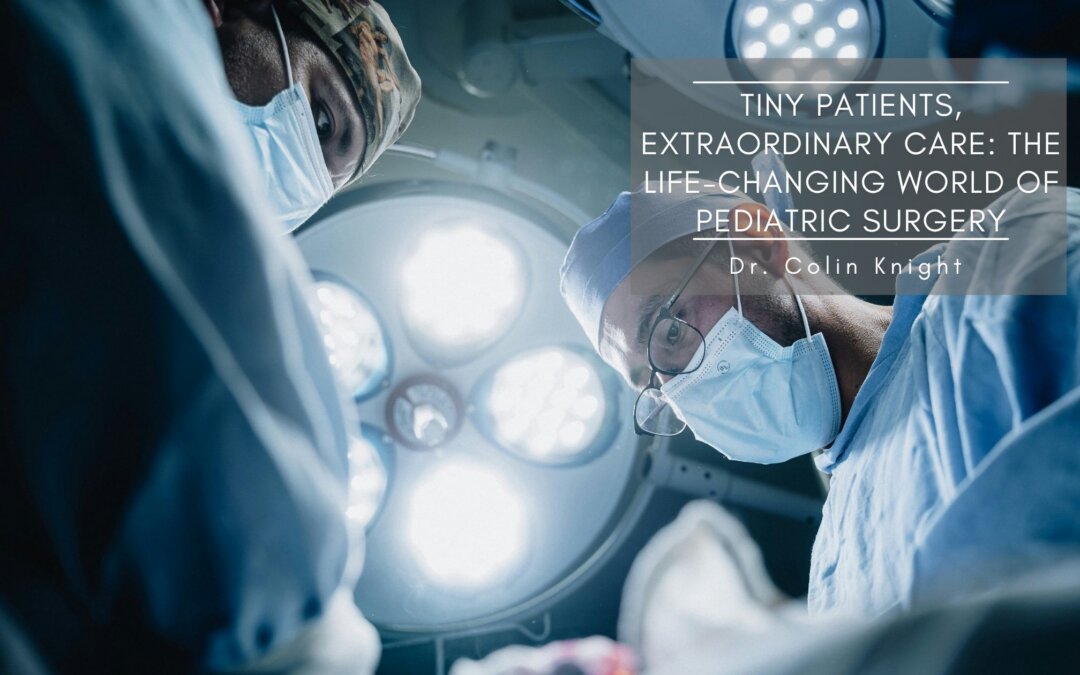
After more than two decades operating on children, first during my fellowship and now in clinical practice in South Florida, I have become reasonably fluent in what we mean by pediatric surgery. It is the branch of surgery devoted to infants, children, and adolescents. We correct congenital anomalies, manage abdominal and thoracic emergencies, and remove tumors. The work spans a premature baby who weighs less than a kilogram to a fifteen-year-old with appendicitis, and the technical, physiologic, and emotional considerations shift at every step.
The cliché in our field is that children are not small adults, and like most clichés it has roots in truth. A neonate’s airway is smaller, more anterior, and more easily obstructed. Drug clearance changes month by month in the first year of life. Tissue heals differently in a growing body, and bones remodel in ways that an adult orthopedist would never expect. After medical school and a general surgery residency, pediatric surgeons spend an additional two years of fellowship training to learn these differences. The case logs are demanding, but the work that follows has been some of the most rewarding in my career.
A large portion of my practice involves congenital anomalies. Some children are born with intestinal obstructions, abdominal wall defects, or malformations of the lungs, kidneys, or chest wall. Many of these conditions are diagnosed prenatally now, which gives the family and the surgical team time to plan delivery at a center equipped to operate within hours of birth. Early correction lets a child grow on a normal trajectory rather than spending years adapting around an unrepaired problem. I find this work particularly satisfying, because the same operation that takes a few hours in the operating room reshapes the next eighty years of a person’s life.
Emergencies make up the other half of the practice. Appendicitis remains the most common reason a child meets a surgeon at two in the morning. Trauma is next, ranging from a clean fracture after a bicycle fall to blunt abdominal injury after a motor vehicle crash. Children compensate well until they do not, and a child who looks stable can decompensate in minutes. The work demands rapid assessment, decisive intervention, and a tolerance for uncertainty that you build only through years of practice.
The technology has improved in remarkable ways since I trained. Laparoscopic and robotic-assisted techniques are now standard for many operations that once required a long open incision. I perform most appendectomies through a single, 12 mm incision. The child goes home sooner, the scar is barely visible at a year, and postoperative pain is meaningfully less. Not every operation should be minimally invasive, but the range of procedures that can be done this way keeps expanding.
Technical skill is only part of the job. A four-year-old does not understand why the people in masks are taking him away from his mother, and that fear is its own clinical problem. Most pediatric hospitals now employ child life specialists, whose work is to translate the medical environment into something a child can move through without terror. They use medical play, picture books, and rehearsal with toy syringes and masks. I have watched a child life specialist take a screaming three-year-old and have her giggling on the operating room table within ten minutes. It is its own skilled practice, and I admire it.
Parents carry their own weight. I have learned over the years that the consent conversation matters as much as the operation itself. Parents need to understand what I am going to do, what could go wrong, and what recovery will look like at home next Tuesday. They need it in language that respects their intelligence without burying them in jargon. The conversation I have with a family before a planned operation differs from the one I have at three in the morning after their child has just been intubated following a crash. Both demand honesty. Neither rewards rehearsed scripts.
The research has kept pace. Survival rates for conditions that were fatal in the 1970s, like gastroschisis or congenital diaphragmatic hernia, are now in the high nineties at experienced centers. Fetal surgery, which sounded like science fiction when I was a medical student, is now offered for a small but growing set of indications. Imaging, anesthesia, neonatal intensive care, and surgical technique have all improved together, and the gains compound. A baby born today with a condition that would have killed her thirty years ago often goes home with her parents and grows up unremarkable.
None of this work is solo. A pediatric surgeon depends on pediatric anesthesia, pediatric radiology, pediatric pathology, neonatal and pediatric intensive care, and a nursing staff trained specifically in children. The surgeon gets the visible credit, but the outcome is built by every member of the team. When I move from one hospital to another, I notice the difference immediately, and it is rarely about the surgeons. It is about the rest of the system.
I tell people who ask why I chose this specialty that the answer is on the other side of the operation. An adult patient lives with a surgical scar for thirty or forty years. A child lives with it for eighty. The arithmetic is simple, and it pulls me back to the operating room every week, after more than two decades of doing this work.